
The Demographic Tsunami Reshaping Singapore’s Care Economy
Singapore is hurtling toward a demographic milestone that will fundamentally reshape its healthcare landscape. By 2026, the city-state officially becomes a “super-aged” society, with more than 21% of its population aged 65 and above. This isn’t merely a statistical footnote—it represents a seismic shift in care demand that the current healthcare workforce is structurally unprepared to absorb.
The Ministry of Health has been remarkably transparent about the scale of the challenge. Singapore’s healthcare workforce is projected to grow by 20% from 129,000 in 2024 to approximately 156,000 by 2030. That translates to roughly 27,000 additional healthcare professionals in just six years—a target that demands not only aggressive recruitment but fundamental rethinking of how care is delivered.
The Math Behind the Shortfall
The arithmetic is unforgiving. Elderly patients typically present with multiple chronic conditions simultaneously, requiring longer consultation times, more intensive monitoring, and coordinated care across multiple specialties. A single 75-year-old with diabetes, hypertension, and early-stage dementia consumes exponentially more clinical resources than a healthy 40-year-old. Multiply that by a rapidly expanding cohort of seniors, and the demand curve steepens dramatically.
Ministry of Health data reveals that the public healthcare system’s overall vacancy rate remains “low,” but this headline figure masks critical skill shortages in specific areas. The gaps are most acute in community nursing, geriatric medicine, and allied health specialties—precisely the domains that an ageing population requires most.
Healthier SG: A Double-Edged Sword
The Healthier SG reform, launched to shift the system’s centre of gravity toward preventive and primary care, has introduced its own workforce pressures. A 2026 study applying the Workload Indicators of Staffing Need (WISN) methodology to public polyclinics found that family physicians were operating at only 79% of required capacity—a staffing shortfall of six full-time equivalents that translates directly into overworked doctors and longer patient waits.
The reform’s ambition is sound: catch chronic conditions earlier, reduce acute hospital admissions, and keep seniors healthier for longer. But executing that vision requires a frontline workforce that simply doesn’t exist at current training and recruitment levels. Expanding primary care capacity without expanding the primary care workforce creates a bottleneck that undermines the entire reform agenda.
Beyond Headcount: Rethinking Care Models
Health Minister Ong Ye Kung has consistently emphasised that Singapore cannot simply “hire its way” out of this challenge. The Ministry’s multi-pronged strategy includes diversifying training pathways, increasing local intakes, recruiting foreign healthcare workers in shortage areas, and securing government-to-government manpower agreements with regional partners.
But the more transformative work is happening at the care model level. The National University Health System has piloted a “Nurse-On-Demand” deployment model that brings greater agility to daily staffing operations, allowing hospitals to flex resources based on real-time patient acuity rather than rigid rostering. The Centre for Healthcare Innovation’s Workforce Accelerator, launched in July 2026, is prototyping 36 reimagined healthcare roles—including a “Nurse Choreographer” who coordinates end-to-end care for complex patients across providers.
These are not cosmetic changes. They represent a fundamental recognition that the traditional physician-centric, hospital-heavy care model cannot scale to meet the needs of a super-aged society. Singapore’s healthcare workforce challenge is ultimately a design problem: the system must be rebuilt around team-based, technology-enabled care that leverages every professional’s skills to their maximum potential.
The Retention Imperative
Recruitment alone won’t solve the equation. The Ministry of Health acknowledges that “young Singaporeans have diverse interests, and healthcare is already taking a good share of every cohort every year”. Nursing school intakes have increased from 2,100 in 2022 to nearly 2,300 in 2025, but there are limits to how much this can be expanded without diluting quality or cannibalising other critical sectors.
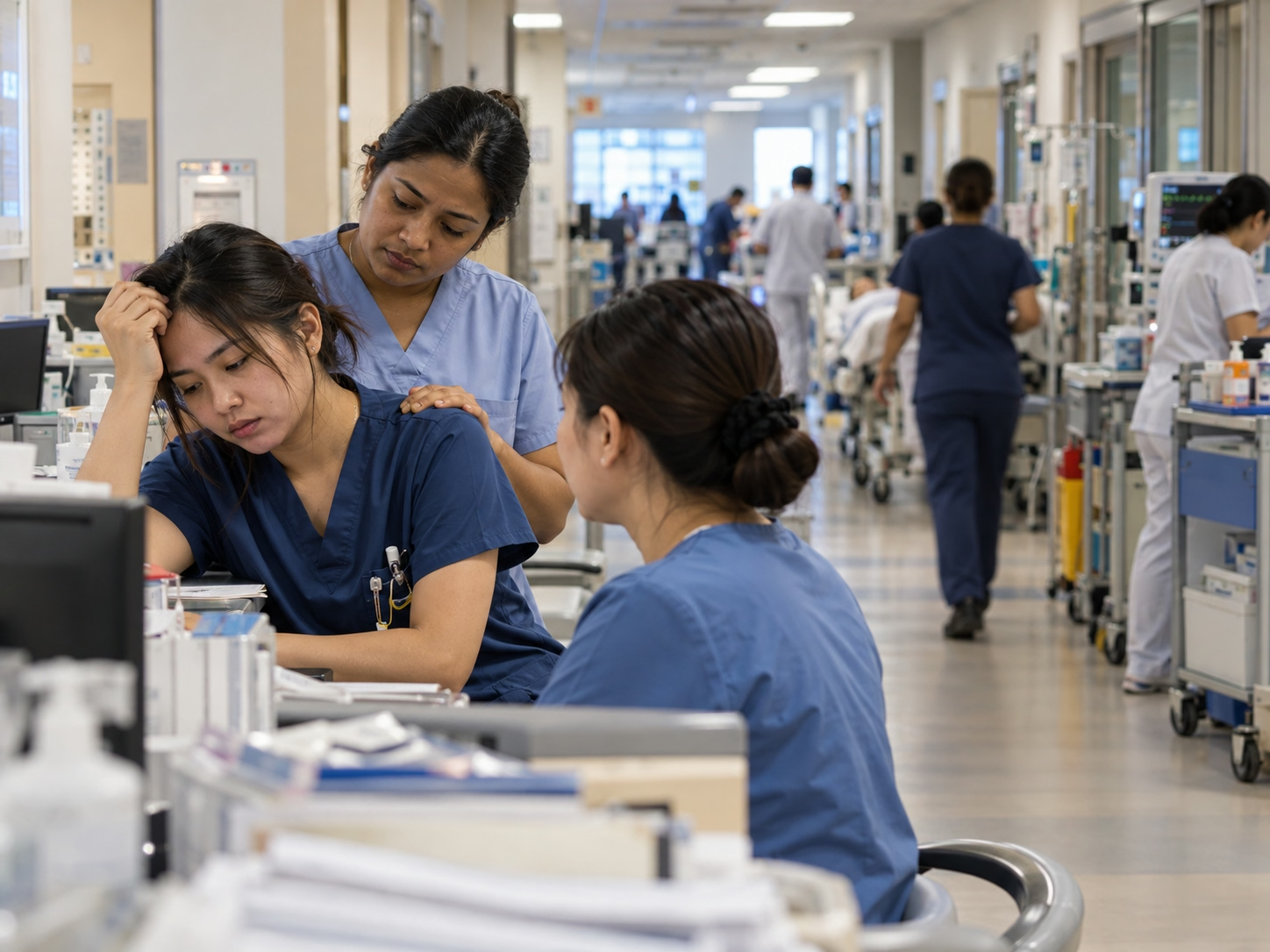
The real leverage lies in retention. About 80% of nursing graduates enter the profession, but only 70% remain after five years. Improving that five-year retention rate by even a few percentage points would add hundreds of experienced nurses to the workforce annually—professionals who already possess the clinical judgment and institutional knowledge that new graduates take years to develop.
Singapore’s healthcare workforce challenge is not simply a numbers game. It is a test of whether the system can reinvent itself quickly enough to serve a population that will need more care, more compassion, and more coordinated attention than any generation before it. The 20% growth target is necessary but insufficient. The real transformation lies in how that workforce is trained, deployed, supported, and sustained.