A Long Life, But Not Always a Well Lived One
Singaporeans are living longer than almost anyone on earth. In 2026, women can expect to reach 87.5 years and men 83.1 years—the longest lifespans globally. Yet the years spent in good health tell a different story. Population-health estimates place Singapore’s healthy life expectancy roughly a decade shorter than total life expectancy, meaning the final ten years of an average Singaporean life are often lived with illness, disability, or declining function.
That gap is the central puzzle of healthy longevity. It is not a failure of healthcare—Singapore’s system is among the world’s most effective at acute care—but a consequence of success. As more people survive into their eighties and nineties, the burden of chronic conditions, frailty, and cognitive decline expands. The question is no longer how to add years, but how to make those added years worth living.
From Lifespan to Healthspan: A Policy Pivot
The Singapore government has made the healthspan gap an explicit national priority. At the National Celebration of Seniors in October 2026, Senior Minister of State Tan Kiat How framed the mission in plain terms: “We want good years, not just more years.” That language reflects a shift from counting birthdays to measuring functional independence—the ability to live safely, confidently, and meaningfully in one’s own community.
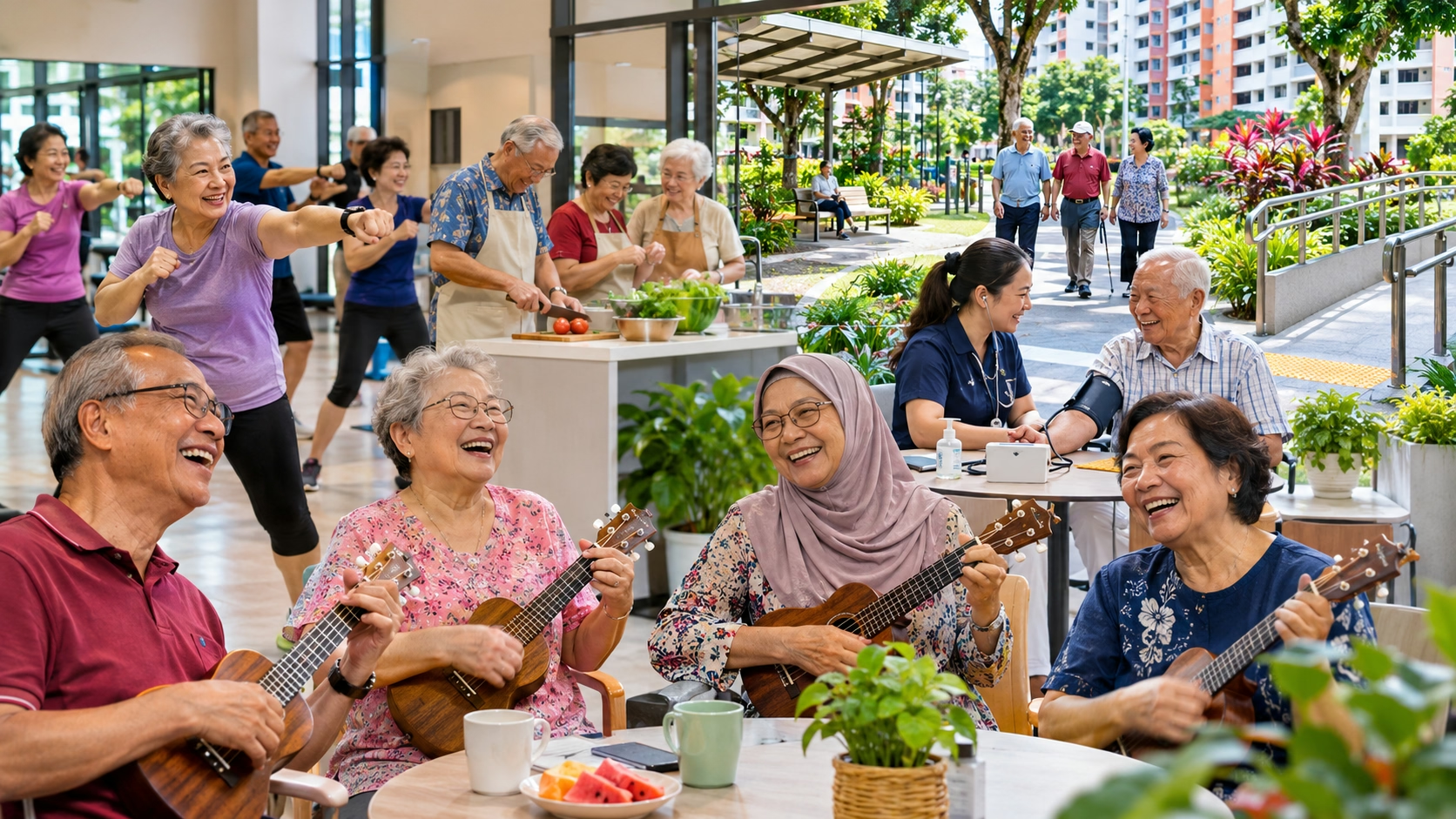
The policy architecture behind this shift is broad. Retirement and re-employment ages are being raised to 65 and 70 respectively, allowing older Singaporeans to remain economically and socially engaged. Healthier SG, launched in 2023, has enrolled residents with a regular family doctor and pushed preventive screening into the mainstream. Age Well SG is rebuilding neighbourhoods around the needs of older residents, with Active Ageing Centres, befriending services, and communal dining as core infrastructure.
These are not isolated programmes. They form a life-course strategy: keep people well in midlife so they arrive at old age with greater physiological reserve, then surround them with community support that slows functional decline.
The Measurement Problem
A critical obstacle to closing the gap is measurement. Chronological age tells clinicians almost nothing about how a person is actually ageing. Two 65-year-olds can look identical on paper yet face vastly different trajectories toward frailty or independence. Researchers at the National University Health System have developed LinAge, a biological ageing clock that uses routine clinical data to estimate how fast a body is ageing beneath the surface. The tool is designed to flag accelerated ageing before functional decline becomes visible, allowing doctors to intervene earlier and personalise preventive care.
Measurement matters because resources are finite. If the health system can identify who is ageing fastest—and why—it can target intensive preventive support where it will do the most good, rather than spreading generic advice across the population.
The Real-World Test
The healthspan agenda will be judged in the neighbourhoods. Toa Payoh, Singapore’s first Age Well Neighbourhood, is the test bed for integrating health, social care, and the built environment around older residents. Three more neighbourhoods—Bedok, Bukit Panjang, and Tiong Bahru-Redhill—are being developed, covering more than 110,000 seniors.
The lesson from these sites is that longevity is not a clinical outcome alone. It is produced by daily routines: a walk to the market, a friend who checks in, a community nurse who notices a change in gait, a chair that is easy to rise from. Singapore’s bet is that by redesigning those routines, the decade of poor health can be compressed—and the good years extended.