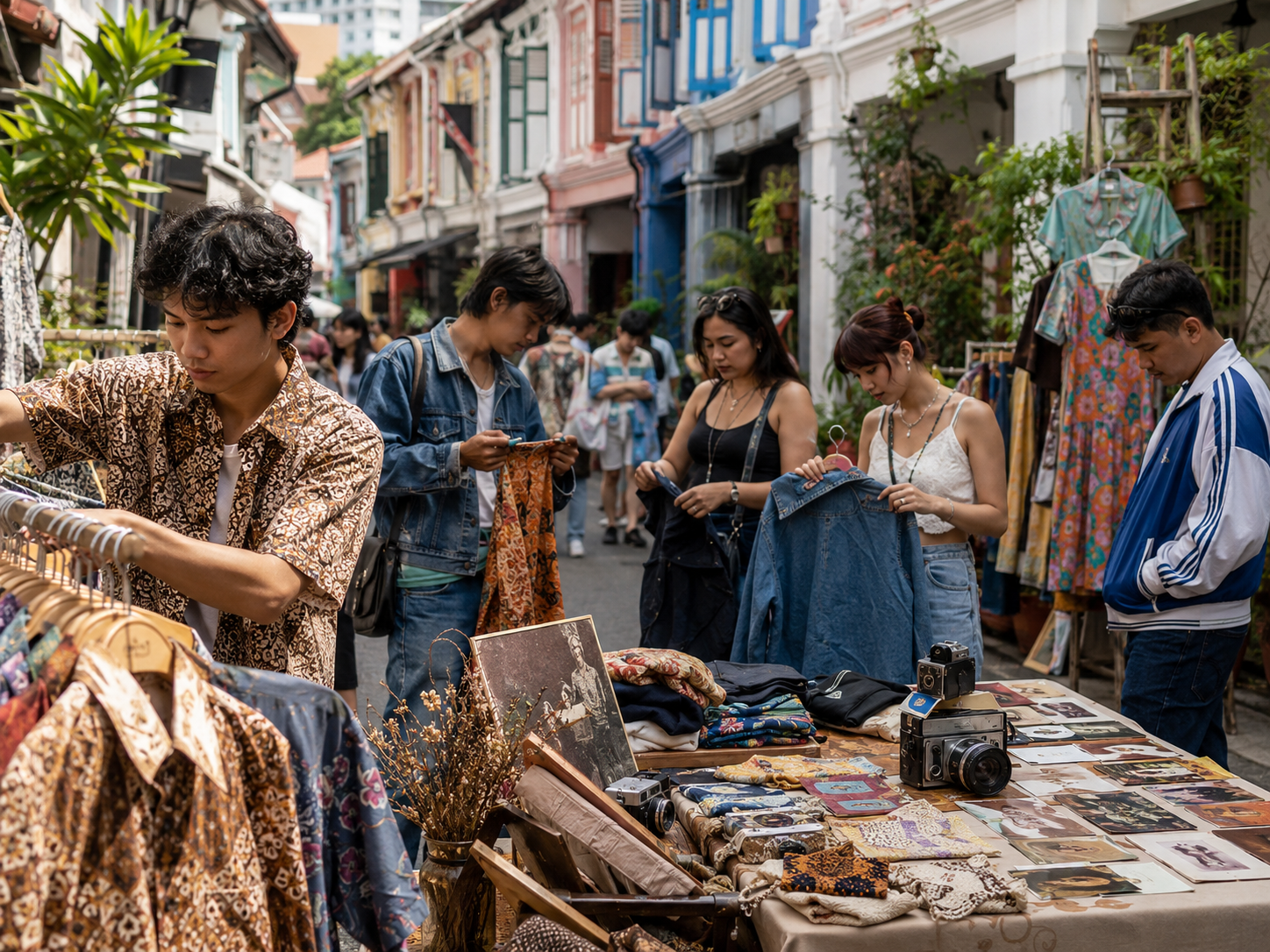
On a humid Saturday afternoon along Haji Lane, a narrow street in Kampong Gelam, a young vendor arranges a rack of 1970s batik shirts. Each shirt carries a small handwritten tag: the year it was made, the textile mill, and the name of its previous owner. This is not a museum exhibition. It is a monthly vintage market, and the vendor is part of a growing community that treats secondhand clothing as a vessel for cultural memory. In 2026, Singapore’s vintage fashion community has evolved from a niche shopping scene into a form of heritage activism.
From Weekend Thrifting to Community Archiving
The shift is visible in the programming around vintage events. Community-led markets at Aliwal Arts Centre, the Malay Heritage Centre and Kampong Gelam now include repair clinics, oral history booths and styling workshops. Organisers say the goal is not merely to sell clothes but to document how Singaporeans dressed across generations. A 1980s high-waisted denim jacket, for example, is not displayed as a generic “retro” item; it is presented alongside stories about local denim culture and the rise of Orchard Road boutiques.
Why Haji Lane Remains the Cultural Anchor
Haji Lane has hosted independent vintage boutiques for more than two decades, but its role has deepened. Stores such as Loop Garms and Vintagewknd now run weekly educational sessions on fabric identification, era-specific silhouettes and garment repair. According to the National Heritage Board’s 2026 Heritage Activation Nodes programme (nhb.gov.sg), participation in community-led heritage fashion events across Kampong Gelam rose 34 percent compared to 2024. The programme recognises that intangible cultural heritage can be transmitted through clothing, from Peranakan embroidery to 1990s Singapore street style.
The Collector as Community Custodian
This community-driven approach is changing consumer behaviour. Instead of asking where an item was purchased, shoppers now ask about its provenance. Young professionals in their late twenties and thirties are forming collecting circles focused on specific eras: 1960s mod dresses, 1980s Singapore-made labels, early 2000s Y2K sportswear. These circles collaborate with local historians and independent researchers, turning private wardrobes into public archives.
Social Media’s Educational Turn
Instagram and TikTok have amplified the movement. Hashtags such as #SgVintageCommunity and #HajiLaneFinds generate thousands of posts monthly. Micro-influencers with fewer than 10,000 followers document sourcing trips to Peninsula Shopping Centre and Lucky Plaza. Their content rarely focuses on haul videos; instead, they explain fabric composition, historical context and restoration techniques. This educational tone has made vintage fashion more accessible to newcomers who may feel intimidated by traditional luxury vintage stores.
Cultural Activism Through Wardrobe Choices
At its core, Singapore’s vintage community is practising a quiet form of cultural activism. Wearing a 1980s Singapore-made shirt or a rare local streetwear label is a statement against the homogenisation of global fast fashion. It is also an assertion that Singaporean fashion history deserves recognition. Organisers reject the label of nostalgia for nostalgia’s sake; they call themselves memory workers. By preserving and wearing old clothes, they argue, Singaporeans keep alive the visual language of the city’s past and ensure it remains part of the present.
As community organisers plan to bring vintage heritage programmes into schools and community centres, retro fashion is likely to become a shared civic practice rather than a niche hobby.