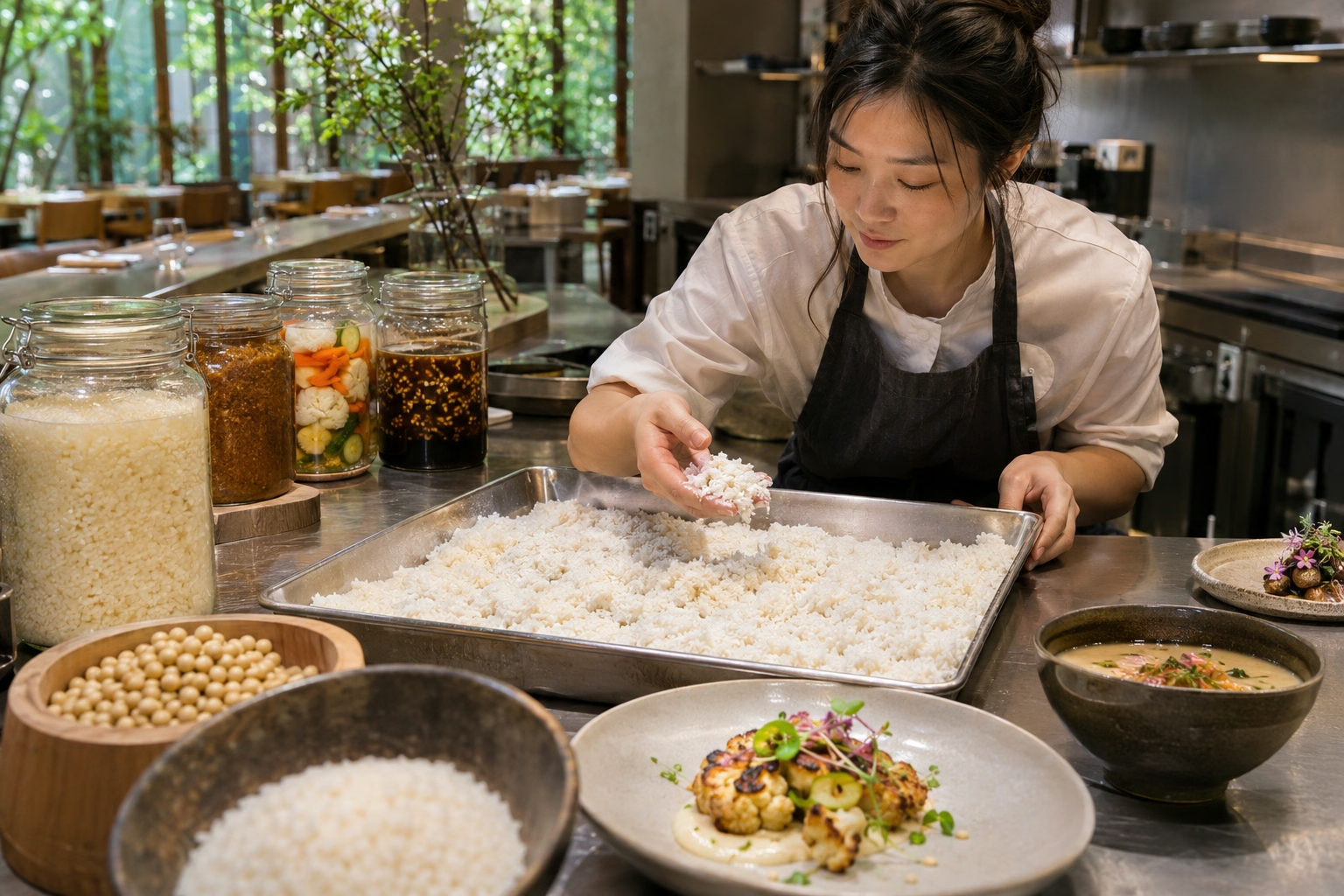
Walk into Wakamama Omakase on a weekday afternoon and the kitchen smells faintly of steamed rice and something sweeter, deeper — a aroma that has nothing to do with a bubbling pot of stock. Chef Joyce is checking a tray of rice grains furred with white mycelium. That fur is Aspergillus oryzae, the mould the Japanese call koji, and it is doing the quiet work that used to be reserved for aged meat and long-simmered fish bones. In a city where plant-based cooking often leans on commercial yeast flakes and mock meats, a growing cluster of Singapore kitchens is rebuilding savouriness from the microbe up.
The mould that makes the menu move
Koji is not an ingredient in the ordinary sense. It is a living starter: cultivated on rice, barley or soybeans, it releases amylases, proteases and lipases that crack starches into sugars, proteins into amino acids and fats into aromatic compounds. The result is glutamate-driven depth without animal protein — the same mechanism behind sake, miso and shoyu, now applied to vegetables, grains and legumes.
At Wakamama, koji shows up in several forms. Shio koji — koji, salt and water — cures seasonal vegetables, drawing out a rounded savoury sweetness that stands in for bonito dashi. Shoyu koji, cultured in soy sauce, becomes a concentrated finishing condiment closer to aged meat jus than to the thin soy sauce on a supermarket shelf. And the kitchen’s house chickpea miso, aged for months, forms the hidden umami layer beneath soups and glazes. None of this is a gimmick. It is the foundational craft that lets a vegan tasting menu carry the weight of a protein-centred one.
A wider shift, not a single restaurant
The technique has moved well beyond one kitchen. AIR CCCC in Dempsey, described in a 2026 Forbes review as “circular-economy dining in a full campus,” uses koji, miso and natto to build depth in dishes that might otherwise rely on animal stocks or imported condiments. At ASIN, the Carpenter Street restaurant that opened in May 2026 under chef Ace Tan, fermentation is not a side project but the philosophical spine: the menu is built around seasonality, house ferments and a “progressive Asian” reading of East Asian cooking. Tan’s previous restaurant, Asu, had already earned a reputation for ageing techniques and in-house ferments; ASIN extends that research-driven approach into a full tasting-menu format.
What the market is telling us
This is not only a chef’s story. Singapore’s fermented foods market was valued at USD 0.97 billion in 2024 and is forecast to reach USD 1.68 billion by 2033, growing at a CAGR of 6.29% over 2026–2033, according to Deep Market Insights. That growth is visible on menus: a miso made from local soybeans, a garum built from fermented mushroom rather than fish, a lacto-fermented chilli paste standing in for stock — all of these are now part of the fine-dining vocabulary in Singapore.
The significance is not that Singapore has discovered koji. It is that koji has stopped being a Japanese import and become a local technique — one that answers a very Singaporean question: how do you build deep, layered flavour without leaning on the same animal proteins the region has always relied on? The answer, increasingly, is growing on a tray of rice.