
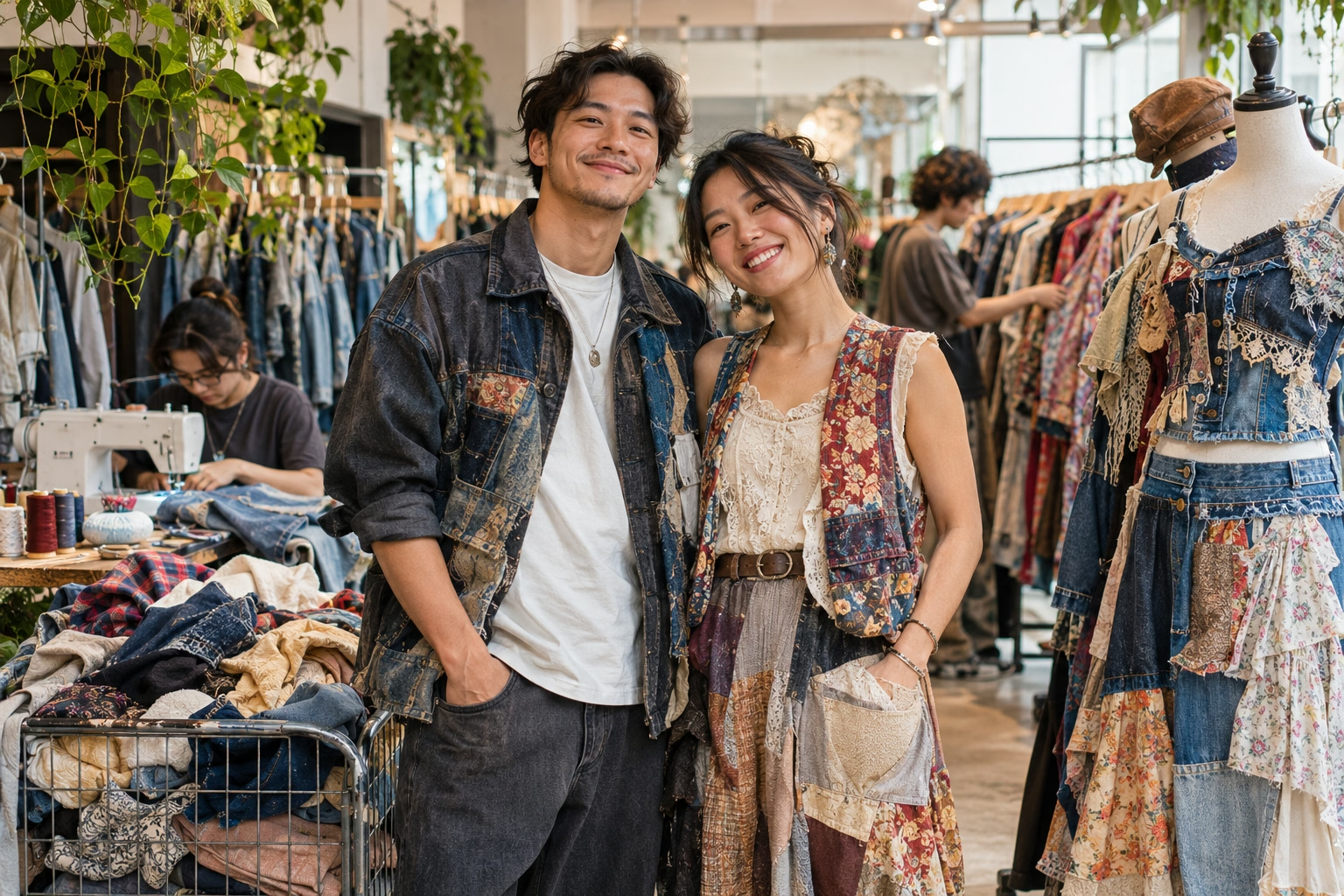
In Singapore’s Indian households, a quiet surplus sits folded in cupboards — saris worn once for a wedding or a prayer session, then rarely seen again. The Dori, a circular fashion label founded by three 27-year-old childhood friends, has built its debut collection around this overlooked inventory. Named after the Hindi word for thread, the brand launched in July 2026 with 45 one-of-a-kind shirts made from donated saris, priced between S$125 and S$190. The response was not modest: roughly 200 people turned up to a launch that had expected 80, and two-thirds of the collection sold on the day.
Design That Refuses to Erase the Fabric’s Memory
What separates The Dori from conventional upcycling is its design philosophy. Each shirt is constructed around the pallu — the decorative end of the sari, often the most intricate part of the textile — while borders become cuffs, plackets, or back yokes. No two pieces are identical, and every shirt carries a tag detailing the fabric type, the Indian state it came from, and the motifs it holds. The result is a garment that does not simply reuse cloth but preserves provenance.
A Market Signal Beyond Nostalgia
The Dori’s traction points to a broader consumer shift in Singapore: willingness to pay a premium for uniqueness and narrative, not just sustainability claims. The brand’s co-founder Rishabh Sharma identified a gender gap in sari upcycling — most existing efforts focused on womenswear — and built a unisex line that lets the fabric’s craft travel across wardrobes. For younger Singaporean Indians, the project also reconnects them with weaves and textures previous generations grew up around. This is reworked fashion as cultural continuity, not just waste diversion.
The Data Behind the Cupboard Economy
The Dori’s model gains urgency against Singapore’s textile waste reality. Cloop, a local circular fashion enterprise, reports that 231,000 tonnes of clothing and textiles were discarded in Singapore in 2025, with only 3% — about 6,000 tonnes — recycled, citing National Environment Agency 2026 statistics. Every sari diverted into a shirt is a small but measurable interruption of that linear flow. The Dori’s approach also sidesteps a common upcycling bottleneck: sourcing. By collecting from family networks and the Indian diaspora, the brand accesses material that charity channels often struggle to absorb, because ethnic wear has limited resale pathways.