From Hiap Heng Kee to 33 Vegetarian Food
For nearly three decades, Sow Kai Leng sold traditional chicken rice at Teck Ghee Market & Food Centre in Ang Mo Kio. He started at 29 in Geylang Bahru, took over the Ang Mo Kio unit, and built a steady following around a dish that defined his trade. In 2013, he changed everything.
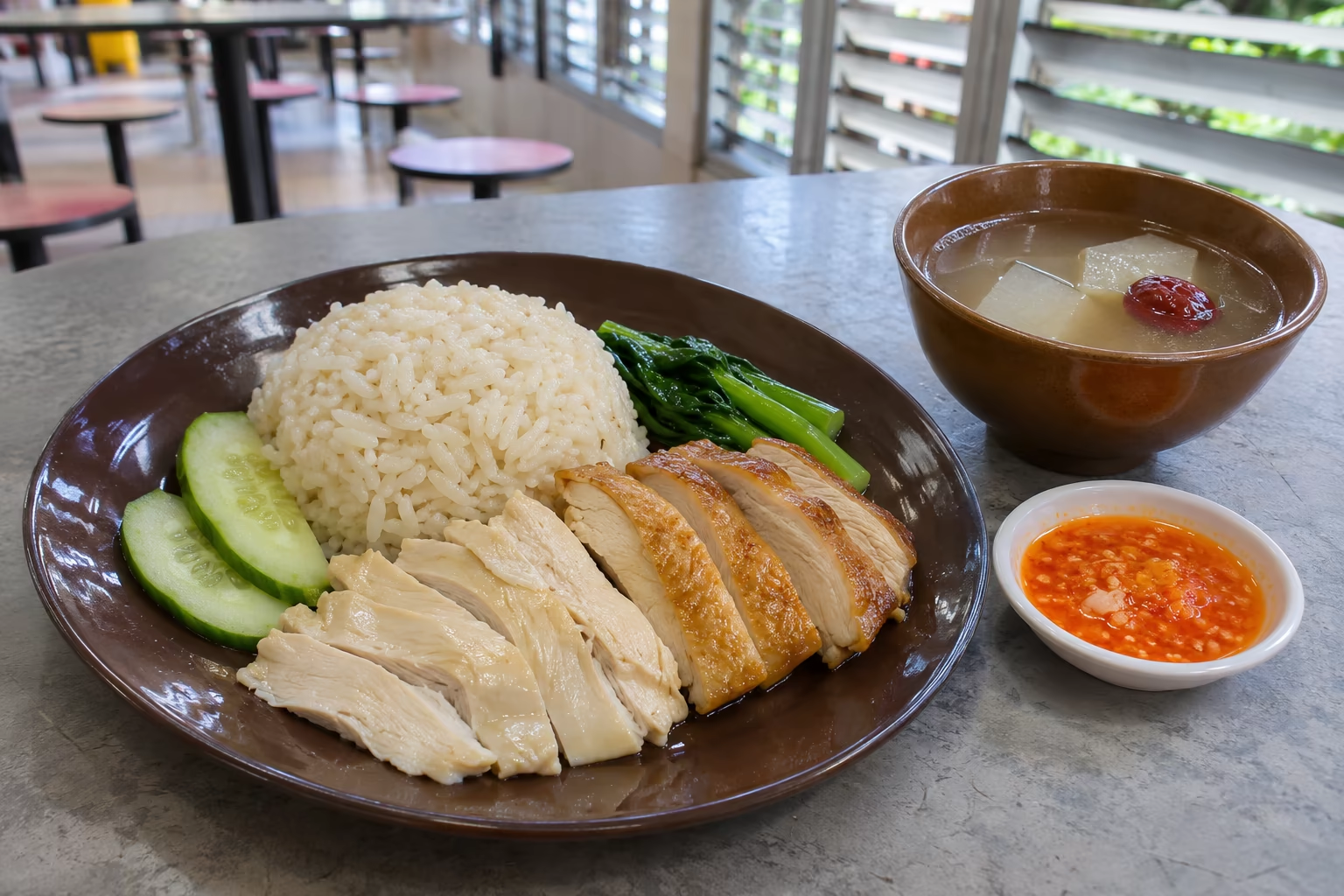
Driven by his Buddhist faith, Sow switched the stall to a fully vegetarian menu and renamed it 33 Vegetarian Food, after its unit number. A fellow Buddhist who ran a vegetarian catering business taught him how to prepare a plant-based version of the dish he had spent most of his life cooking. The result is a plate that The Straits Times described in April 2026 as capable of passing “for the real McCoy, from its pale sheen to its springy texture with a firm bite”.
The Craft of Soy-Based “Chicken”
The “chicken” at 33 Vegetarian Food is made from soya bean, not from the heavily processed plant-based proteins that dominate supermarket shelves. The signature Healthy Vegetarian Chicken Rice Set (S$8) combines steamed and roasted mock chicken with rice, vegetables, and condiments on glossy brown ceramic ware—a presentation that nods to the famed Chatterbox restaurant. The Thai jasmine rice is infused with old ginger, lemongrass, and pandan leaves. The radish soup is boiled for at least two hours with red dates and vegetarian chicken cubes. The chilli, made without garlic or shallots, blends chilli padi and finger chilli with old ginger, galangal, and lemongrass, finished with lemon juice.
The more affordable Vegetarian Steamed Chicken Rice costs S$4.50, with achar as a S$1 add-on. Other options include Vegetarian Thai Chicken With Rice (S$5) and Vegetarian Curry Chicken Noodle (S$5), made with vegetarian chicken cubes, potato, tau pok, and carrot in coconut milk curry.
Why Texture Matters More Than Taste
The 33 Vegetarian Food case reveals a quiet truth about plant-based hawker food: the hardest part is not flavour. It is texture and memory. Sow’s customers are not simply buying a meat-free meal. They are buying a familiar ritual—the sheen of the rice, the resistance of the bite, the sharp lift of ginger-chilli sauce. The stall’s success lies in the fact that the plant-based version does not ask diners to abandon those sensory expectations. It asks them to recognise them in a different form.
This is the interpretive work happening across Singapore’s hawker centres. Plant-based hawker food is not a rejection of local cuisine. It is a re-reading of it, ingredient by ingredient, gesture by gesture.