Singapore has quietly become one of Asia’s most aggressive test beds for entertainment that refuses to sit still on a stage. The city-state’s immersive entertainment market was valued at USD 1.2 billion in 2025 and is forecast to reach USD 10.7 billion by 2034, expanding at a compound annual growth rate of 27.15% . That figure is not merely a reflection of consumer appetite—it signals a structural shift in how venues, producers, and tourism authorities approach the concept of a “show.”
From Spectator Sport to Participatory Environment
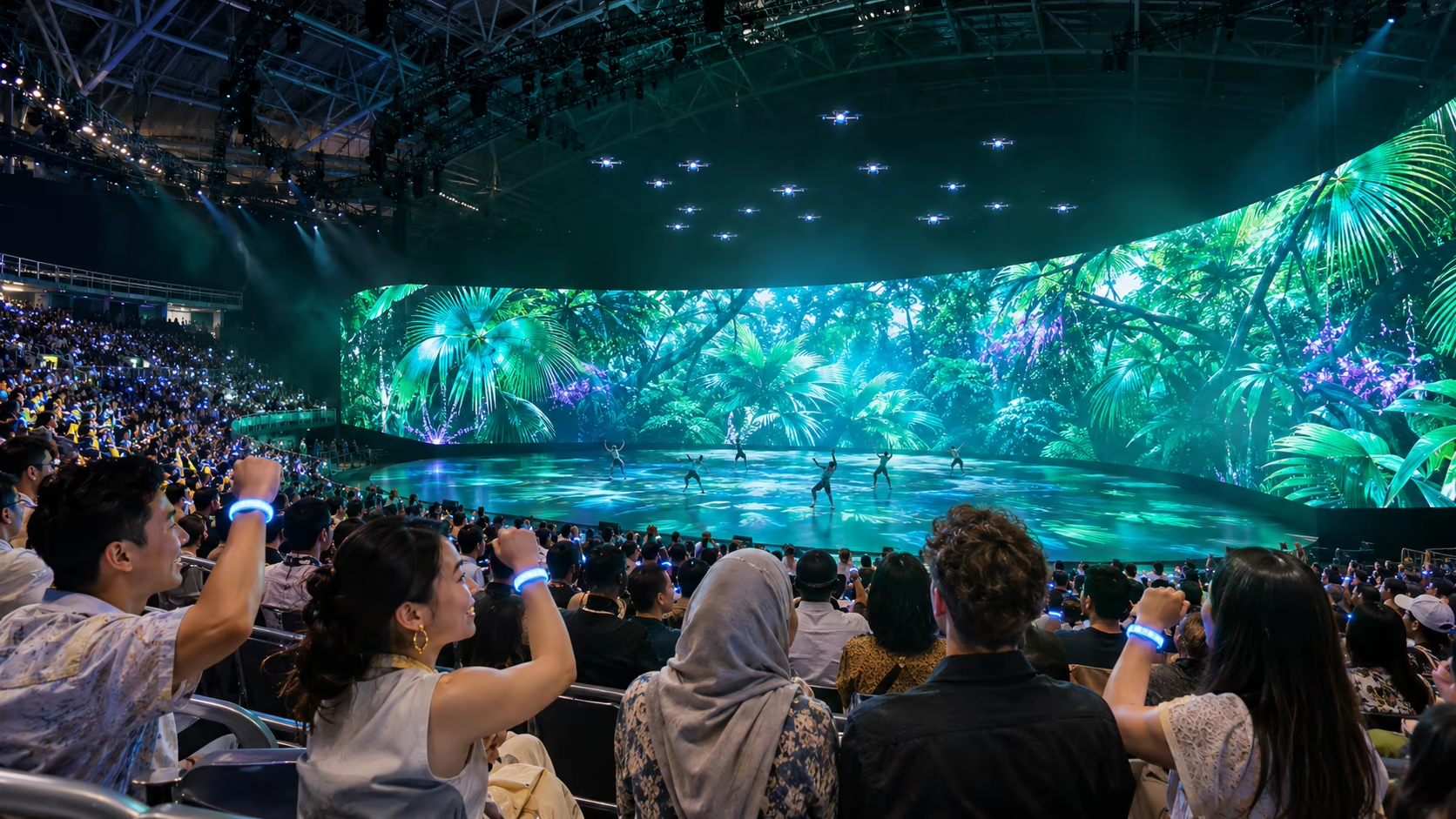
The clearest evidence of this shift arrived during Singapore’s 2026 National Day Parade at the National Stadium. The production featured 300 indoor drones, aerial acrobatics, and a stage stretching 162 meters—the largest and most complex in recent years. Audiences wore upgraded LED wristbands capable of displaying text and graphics, turning thousands of spectators into a live visual component of the performance itself . Creative director Tan Yinglian confirmed that artificial intelligence was used to extrapolate future versions of characters for on-screen projections, blending predictive technology with live storytelling .
What makes the NDP case instructive is not the technology alone. It is the intent. Organizers explicitly described the production as an “immersive performance” designed to shock audiences the moment they entered the stadium . That language—immersive as a primary design goal rather than an add-on—is spreading across Singapore’s entertainment ecosystem.
The Venue Arms Race
Beyond one-off events, permanent venues are racing to embed interactivity into their core offerings. In March 2026, Mandai Wildlife Reserve opened Exploria, a 10,000-square-meter indoor multimedia attraction featuring five themed worlds, RFID wristbands that trigger personalized digital avatars, and over 80 interactive installations . Visitors can stand inside a 360-degree theatre surrounded by visuals, light, sound, and motion, or navigate a darkened labyrinth revealing species that live without light .
The Singapore Tourism Board has thrown its weight behind such projects. The upcoming Studio Ghibli immersive exhibition, opening at Gardens by the Bay in December 2026, will span nearly 3,500 square meters and include the world’s first eight-meter-tall three-dimensional recreation of the Spirited Away bathhouse . STB’s director of leisure events framed the exhibition as part of a deliberate strategy to reinforce Singapore’s appeal as the region’s premier lifestyle destination .
Why the Economics Work
The financial logic behind these investments is straightforward. Singapore’s tourism receipts reached a record S$23.9 billion for January to September 2025, with sightseeing, entertainment, and gaming spending each rising 15% . Immersive experiences command premium pricing—Studio Ghibli tickets range from S$39 for local residents to S$55 for standard peak admission —while also extending visitor dwell time and driving ancillary spending on dining and retail.
The market segmentation tells a similar story. In 2025, VR held the largest technology share at USD 480 million, but AR is projected to deliver the fastest growth through 2034 . Live events and concerts accounted for USD 340 million, while immersive theatre and attractions contributed USD 180 million . These are not niche experiments. They are revenue lines with measurable scale.
For producers and venue operators across Asia, Singapore’s trajectory offers a working model: pair government-backed tourism infrastructure with private-sector experimentation, price experiences at a premium, and treat technology as narrative infrastructure rather than spectacle alone. The city-state is not simply hosting immersive entertainment. It is institutionalizing it.