The narrative around sustainable fashion in Singapore has long been dominated by awareness campaigns, swap events, and well-intentioned consumer education. In 2026, that narrative is being rewritten by a quieter but more consequential development: the emergence of viable business models that treat circularity not as a marketing add-on but as a core revenue engine.
From Awareness to Transaction: The Upcycled Ethnic Wear Opportunity
Perhaps the most striking example of this shift comes from an unexpected niche. In July 2026, a circular fashion brand called The Dori launched its debut collection of shirts upcycled from saris sourced from Singapore’s Indian diaspora. The response was immediate: two-thirds of the 45 shirts available sold on the first day, with nearly 200 people attending the launch—almost double the expected turnout . Individual pieces retailed between S$145 and S$187, a price point that would be unremarkable for new fast fashion but represents a premium for garments made from discarded textiles.
What makes this commercially significant is not the launch itself but the underlying supply logic. Every Indian household, as one fashion content creator quoted in local media observed, contains saris “folded away and waiting”—garments worn once for a wedding or festival and then rendered socially unusable for repeat occasions . The Dori’s founders built a business around unlocking this dormant inventory. Each shirt carries a tag detailing the fabric type, the Indian state of origin, and the specific motifs and embroidery it carries. No two pieces are identical. The model converts cultural specificity into scarcity, and scarcity into pricing power.
The Infrastructure Behind the Aesthetics
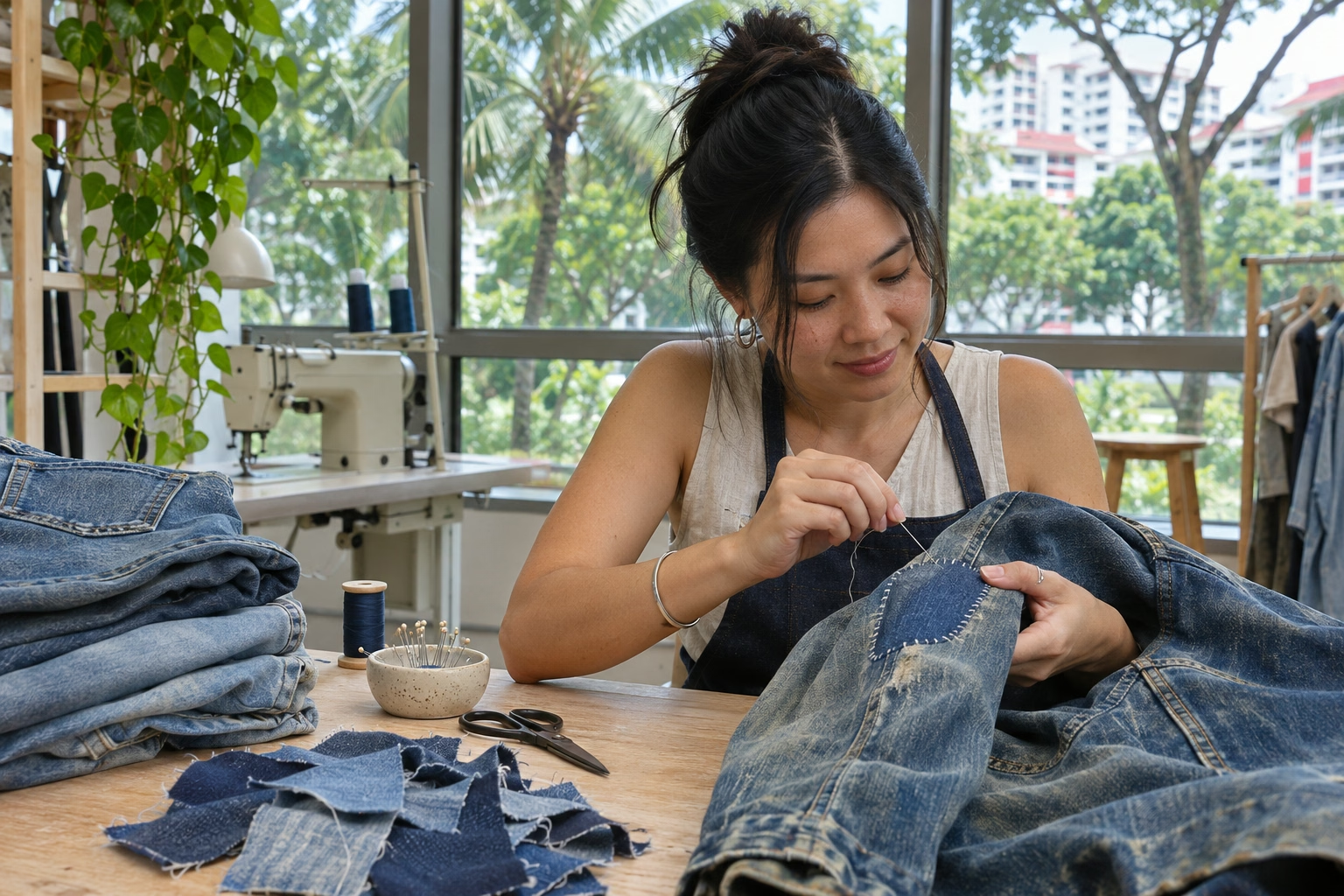
This commercial activity is unfolding against a backdrop of deliberate institutional investment. In May 2026, the Singapore Fashion Council launched IMPACT Retail, a three-year programme funded by the SG Eco Fund and industry partners, with a structured material focus: denim in 2026, bio-based materials in 2027, and plastic circularity in 2028 . The programme combines exhibitions, workshops, and a curated retail showcase featuring eight local labels at Design Orchard. Unlike previous awareness-driven initiatives, IMPACT Retail explicitly positions sustainable fashion as a retail proposition, with the Design Orchard Retail Showcase inviting shoppers to purchase from homegrown brands committed to ethical production.
Meanwhile, the research infrastructure that underpins long-term material innovation continues to develop. The RGE-NTU Sustainable Textile Research Centre, established as Singapore’s first dedicated textile recycling research facility, is working on fibre recovery, eco-friendly decolorization, and energy-efficient processing technologies intended for urban deployment . The centre’s work addresses a critical bottleneck: Singapore currently lacks the domestic capacity to process textile waste, with most collected textiles resold or reused overseas .
The Gap Between Momentum and Scale
The commercial progress of 2026 does not obscure a structural reality. Singapore generated over 206,000 tonnes of textile waste annually, with only about 3 percent recycled in 2024 . The government has explicitly stated that textiles are not yet included in Extended Producer Responsibility schemes due to the complexity of fibre blends and the lack of viable local recycling pathways . Social enterprises like Cloop have even declined donations from ultra-fast-fashion brands, arguing that accepting low-quality garments for resale would amount to becoming a “dumping ground” rather than advancing circularity .
The businesses gaining traction in 2026 share a common characteristic: they are not waiting for policy frameworks to mature. They are building commercial models around the materials, skills, and consumer segments that already exist—saris in cupboards, denim waste streams, and a growing cohort of shoppers willing to pay for provenance and uniqueness. Whether these models can scale beyond boutique volumes remains the central question. But the direction of travel is clear: sustainability in Singapore fashion is no longer merely a campaign. It is becoming a line item.