The Economics of a Single Ticket
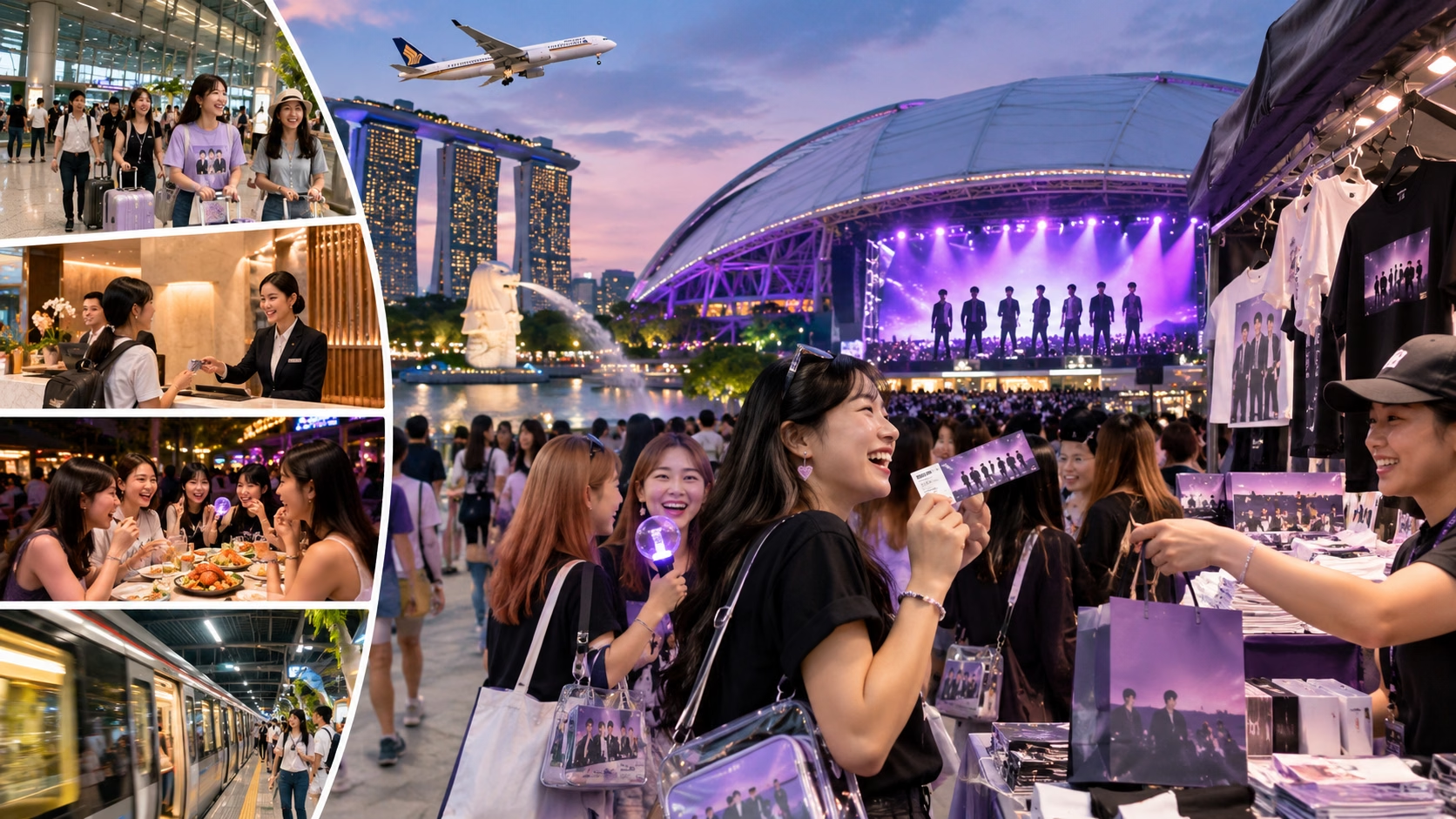
When a fan buys a concert ticket to see BTS at the National Stadium, the transaction does not end at the turnstile. In Singapore, that ticket has become the entry point to a carefully engineered spending chain that stretches from Changi Airport to Bugis hotel lobbies to merchandise queues outside the venue.
The numbers tell a story of deliberate market design. Singapore’s live entertainment market was valued at US$1.29 billion in 2025 and is forecast to reach US$2.08 billion by 2034, growing at a compound annual rate of 5.47 percent . Music concerts represent the largest segment, but the real economic engine sits in the ancillary layers: accommodation, transport, food and beverage, and retail.
BTS and the December Demand Shock
The most current case study is BTS’s four-night run in December 2026. According to Amadeus Travel Intelligence data cited by TTG Asia, international flight bookings to Singapore for December 16 to 23, 2026, rose 62 percent year-on-year, directly coinciding with the concert dates . Hotel occupancy booked for December 17 to 22 reached 32 percent as of late September, up 49 percent from the equivalent booking point in 2025, while average daily room rates climbed to US$237 .
Trip.com’s Singapore general manager Edmund Ong reported that hotel bookings for the concert period increased more than 18 times year-on-year, with some properties quoting rates nearly ten times their usual December prices . DBS economist Chua Han Teng estimated the four BTS shows could add approximately S$200 million to Singapore’s tourism receipts in the fourth quarter of 2026, while Maybank’s Chua Hak Bin offered a higher projection of S$300 million .
The Infrastructure Behind the Spend
This is not accidental. Singapore has invested in a 55,000-seat National Stadium and a 12,000-seat indoor arena specifically designed for large-scale concerts, complemented by an airport and transport network that moves fans from arrival hall to venue seat with minimal friction . The Singapore Tourism Board operates a one-stop service to streamline logistics for foreign event organisers, reducing bureaucratic barriers that might otherwise deter promoters .
The Merchandise Layer
Beyond hotels and flights, merchandise represents a high-margin revenue stream that captures fan spending before and after the show. The fan economy in Singapore increasingly resembles a managed ecosystem where operators monetise not just the performance but the entire journey. As industry observers note, the winner in 2026 is no longer simply the promoter who sells out a stadium, but the operator who converts one moment of fandom into a chain of transactions spanning membership, presale access, room revenue, dining, and repeat visitation .