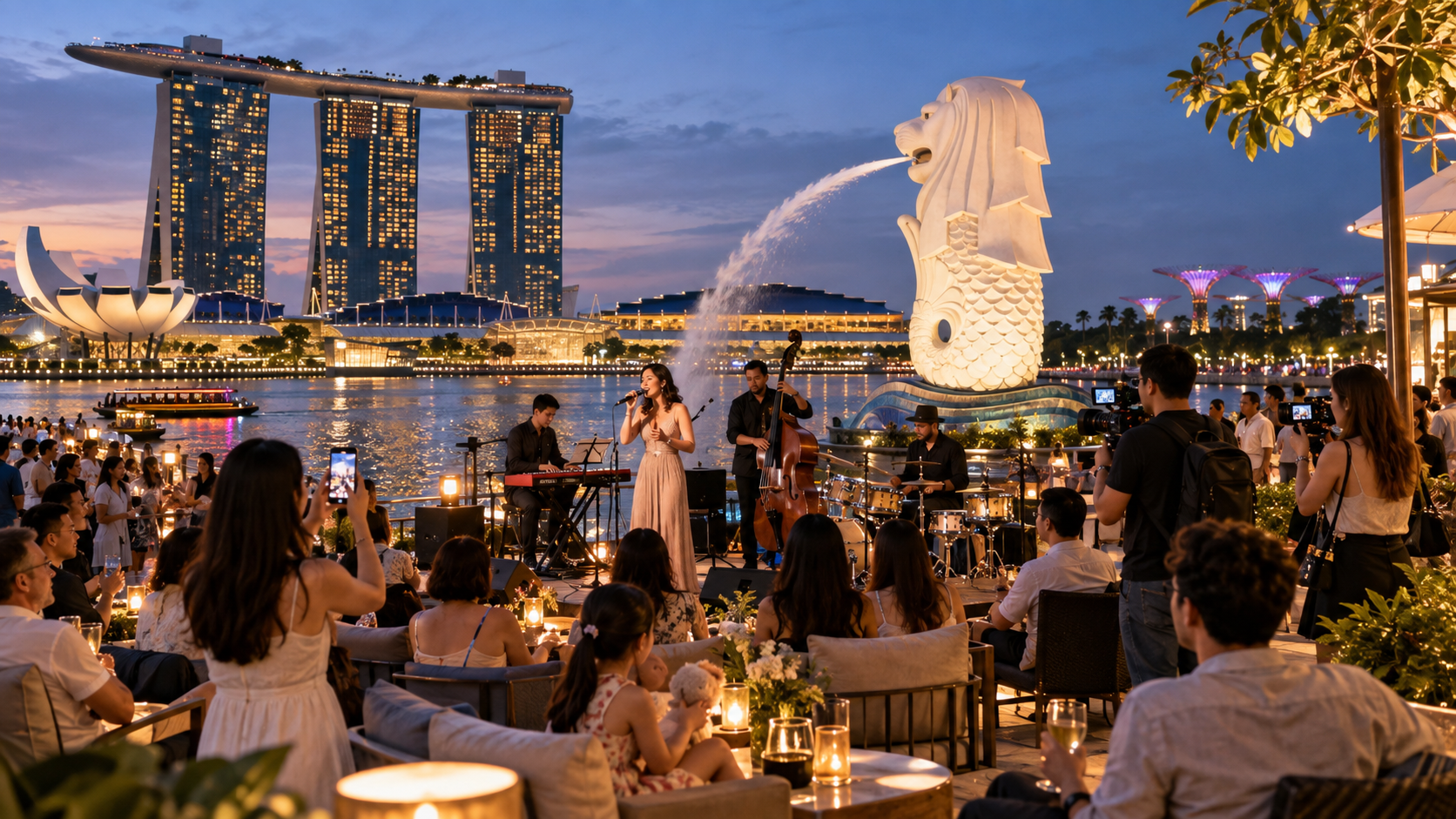
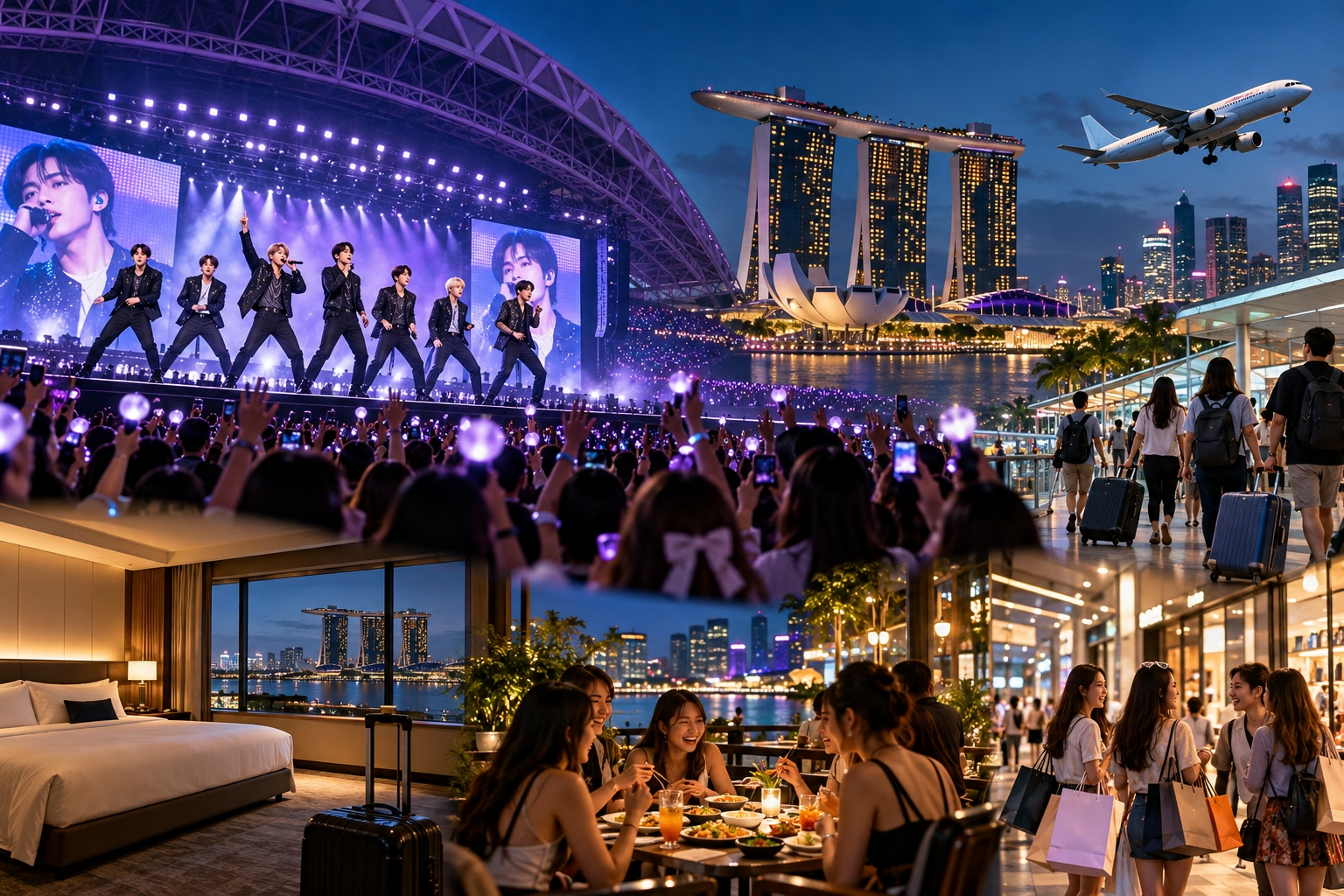
When BTS perform four nights at the National Stadium in December 2026, the economic story will not be told by ticket sales alone. The real number sits in hotel bookings, flight arrivals, restaurant covers and retail receipts across the island. DBS economist Chua Han Teng estimates that the four concerts could add about S$200 million** to Singapore’s tourism receipts in the fourth quarter of 2026, while Maybank’s Chua Hak Bin puts the figure closer to **S$300 million . Those projections matter because they place the BTS residency in the same conversation as Taylor Swift’s six-night Eras Tour run in March 2024, which economists linked to an estimated S$300 million to S$400 million in tourism receipts .
The Multiplier Effect Beyond the Stadium
The exclusivity premium is only the starting point. What distinguishes Singapore’s model is how quickly the demand signal travels through the broader travel economy. Trip.com Singapore reported that hotel bookings on its platform for the BTS concert period increased more than 18-fold, with accommodation searches surging as regional fans locked in travel arrangements months ahead of the shows . Amadeus data published in October 2026 found flight bookings into Singapore rising 62% during analysed concert windows, while average hotel occupancy on concert nights climbed 49% year on year . These are not marginal fluctuations; they represent a concentrated demand shock that reaches airlines, airports, ground transport and food-and-beverage operators within a matter of days.
Why December Timing Amplifies the Return
December is already a high-visibility month in Singapore’s tourism calendar, but hotel occupancy can soften as residents travel overseas. The BTS concerts fill that gap with high-yield international arrivals who are less price-sensitive and more likely to extend their stay . With roughly 55,000 seats per night at the National Stadium, the four shows could represent around 220,000 attendances, and a meaningful share of those attendees will book multiple nights, dine in precincts far from Kallang and treat the concert as the anchor of a year-end city break .
The Strategic Bet Behind the Exclusivity
Singapore’s willingness to pursue exclusive or semi-exclusive arrangements is not a one-off gambit. It reflects a deliberate reading of the concert economy as a demand-aggregation tool in a region with limited cross-border touring infrastructure. A 2026 academic analysis of Singapore’s event exclusivity strategy describes the approach as a form of “event-led economic aggregation” that enhances Singapore’s network centrality and lock-in within ASEAN’s live-entertainment circuit . In practical terms, the city-state is not simply hosting a show; it is positioning itself as the default gateway for regional fans who are willing to cross borders for a single artist.
The Risk Beneath the Headline Numbers
The S$200 million to S$300 million estimates are forecasts, not audited outcomes, and they depend on attendance, visitor spending and how much of the concert-period demand would have existed anyway. Singapore’s 2025 tourism receipts reached a record **S$32.8 billion** on **16.9 million international visitors**, and the Singapore Tourism Board’s May 2026 outlook projected **17 million to 18 million arrivals** with receipts of **S$31 billion to S$32.5 billion** for the full year . Against that base, a S$200 million concert bump is meaningful but not transformative on its own. Its real value lies in what it proves: that Singapore can convert exclusivity into repeatable, high-yield tourism demand—and that the model can be recalibrated for different artists, seasons and fan segments.